
Virse provides streetwear labels, uniform suppliers, and clubs with an AI patch designer on its Creative Canvas to preview custom emblems in embroidered twill, chenille, woven damask, and PVC before digitizing.
United States, 10th Nov 2026 – Virse provides streetwear labels, outdoor clubs, uniform suppliers, and custom merchandise studios with a dedicated AI patch generator inside its node-based Creative Canvas. Built to turn rough emblem ideas, team mascots, and written themes into realistic embroidered patch design concepts, the workflow lets creative teams compare badge silhouettes, border stitches, and backing textures side by side before ordering physical embroidery samples.
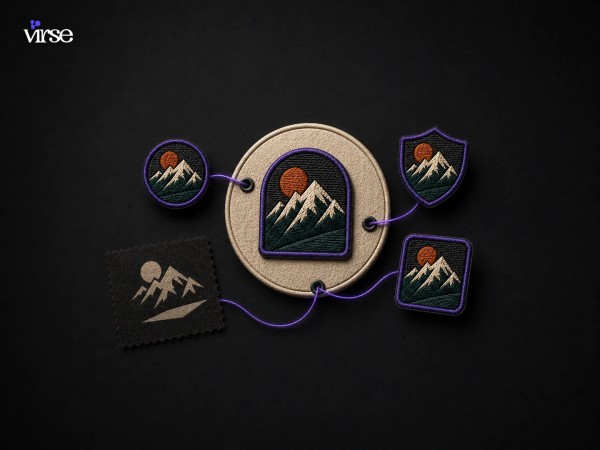
Custom patches remain a staple across workwear jackets, canvas daypacks, tactical unit gear, and collegiate club merchandise. Yet designing a patch that actually holds up in thread is very different from drawing a flat digital sticker. Fine gradient shading, tiny serif text under four millimeters, and crowded line intersections quickly turn into an unreadable blob once a multi-head embroidery machine lays down polyester thread on twill backing. When a club organizer or junior apparel designer sends a flat graphic to a patch factory without accounting for stitch density or border width, the resulting pre-production sample often comes back looking nothing like the original sketch.
Virse helps teams spot those visual trade-offs early by letting them explore patch design online as tactile, material-aware concept renders on an infinite canvas. Instead of guessing how a flat vector logo will look when framed by a heavy overlock stitch, users can generate realistic patch previews that show thread direction, twill weave visibility, and raised border geometry from the very first round of ideation.
Comparing twill, chenille, woven, and PVC patch concepts on one canvas
Different garments and use cases call for completely different badge construction. A heavyweight wool varsity jacket calls for lofty chenille felt, an alpine hiking pack needs a weather-resistant molded PVC or tightly woven badge, and a classic mechanic’s work shirt looks best with a traditional 75% embroidered twill crest and a thick merrowed edge.
When a designer opens the patch generator on Virse, they start by entering the subject, text banner, and badge silhouette, or by dropping an existing crest sketch onto the canvas. From there, the workflow allows teams to compare distinct construction aesthetics side by side. Users can test classic circular and shield crests alongside arched rocker banners, hexagonal cuts, or custom die-cut shapes, comparing thick merrowed overlock borders against flat laser-cut or heat-cut edges.
Designers can also branch a single emblem across multiple canvas nodes to see how the same artwork reads as raised satin-stitch embroidery, fine-detail woven damask, fuzzy varsity chenille, or matte 3D PVC rubber. Using Virse’s 50+ integrated AI models and Aesthetic Memory, teams lock in their seasonal thread palette while testing dark navy, olive drab, or unbleached cotton twill backgrounds. Because every iteration lives as a visible node on Virse’s Creative Canvas, an art director or club committee can review six or eight patch mockup options on one screen, trace each variant back to the original brief, and use Virse Composer to simplify crowded lettering or widen a border in plain language.
“A patch has physical texture, thread sheen, and edge thickness that a flat illustration simply cannot show,” said a spokesperson for Virse. “Virse gives apparel designers and club organizers a fast way to test how an emblem works in embroidered twill, chenille, or woven form before they commit to digitizing and factory sampling.”
Extending patch concepts across backpacks, team jerseys, tees, and coins
In both streetwear fashion and club merchandising, an embroidered badge is rarely developed in isolation. Usually, a patch is one piece of a seasonal capsule drop or an annual commemorative kit. Virse’s connected workspace allows designers to branch their approved patch ai concept directly into companion merchandise tools on the same canvas.
Outdoor and commuter bag brands designing hook-and-loop morale patches or sewn-on front-pocket badges can connect their patch node directly to the ai backpack designer to evaluate how the badge color and proportion sit against ripstop nylon or waxed canvas bag bodies. Sports organizers, collegiate societies, and alumni teams developing sleeve crests or chest emblems can pair their patch concept with the ai baseball jersey generator to verify that the badge colors coordinate cleanly with uniform pinstripes, piping, and player numbering.
Independent clothing labels building a coordinated drop can carry the central mascot or emblem from their jacket patch straight into the ai t-shirt design generator to test chest-pocket or full back-print graphic placements. For military units, first-responder battalions, and anniversary events producing both uniform patches and metal keepsakes, designers can also branch the approved crest into a commemorative challenge coin design board on the same workspace.
Once a collection is finalized, teams can organize all approved badge renders, garment previews, and reusable Smart Nodes inside Virse’s shared Asset Folders so production managers and external vendors work from a single source of truth.
Four steps to create a custom patch concept before digitizing
Designers and organizers follow a four-step workflow on Virse to take an emblem from idea to visual mockup. They describe the central illustration, motto text, and silhouette, or upload a sketch onto the canvas. Second, they select embroidered twill, woven fabric, chenille felt, or PVC, noting whether the edge needs a raised merrowed border or a die-cut trim. Third, they generate concepts across canvas nodes to test thread color combinations and text legibility before refining details with Virse Composer and exporting the visual mockup for their digitizer.
Virse sets clear boundaries around what the tool delivers. The AI Patch Designer generates 2D visual concept renders and surface mockups for creative sign-off and vendor quoting. It does not output machine embroidery stitch files (such as DST, PES, or EXP formats) and does not manufacture physical patches. Users looking for a free ai patch generator trial can start immediately with the 200 free compute credits included on every new Virse account, while studio production runs on Pro, Max, and Business plans supporting up to 50 team seats.
Streetwear labels, uniform coordinators, and club merchandisers can begin testing custom badge concepts directly on virse.ai.
About Virse
Designed by AI researchers and creative technologists whose backgrounds span more than 100 international design awards, Virse is a human-led AI creative system tailored for apparel, merchandise, and brand studios. Headquartered in Dover, Delaware, the platform unifies 50+ generative and production models with Virse Composer and Aesthetic Memory on a node-based Creative Canvas. Teams use Virse to develop emblems, apparel mockups, and seasonal merchandise boards in a single shared environment.
Media Contact
Organization: Virse
Contact Person: Virse Media Relations
Website: https://www.virse.ai/
Email: Send Email
Country: United States
Release id: 50592
View source version on King Newswire:
Virse Accelerates Embroidered Patch Design and Mockups for Apparel Brands
Disclaimer: The views, suggestions, and opinions expressed here are the sole responsibility of the experts. No Euro Watch 360 journalist was involved in the writing and production of this article.